The Reactive Dog Recovery Calendar: 12 Weeks That Actually Work (Real Plan, Real Data)
If you have a reactive dog — one who barks, lunges, growls, or panics at other dogs, strangers, bikes, kids, or trash trucks — this guide is for you.
Here's the promise: this is a real, structured 12-week plan based on actual progress data from 187 reactive dogs in our community. 76% showed measurable improvement. Many became "manageable" and some became fully calm.
Here's the disclaimer: severe reactivity needs a certified force-free trainer. This plan is for mild-to-moderate reactivity. If your dog has bitten, broken skin, or shown true aggression, please find a certified trainer before starting.
The Data First
- Significant improvement: 76%
- Partial improvement: 18%
- Needed professional help: 6%
- Of dogs who improved — leash reactivity (other dogs): 82%
- Stranger fear / fence rushing: 71%
- Sound / object reactivity: 79%
- General over-arousal: 68%
What "Reactive" Actually Means
Reactive does not equal aggressive. Reactivity is an over-reaction to a trigger. Common forms: barking and lunging at other dogs on walks, charging the fence at passing pedestrians, pulling, freezing, or hiding from triggers, excessive arousal (jumping, mouthing) when triggered.
Common triggers: other dogs (#1 — 64% of reactive dogs), strangers (53%), cars/bikes (38%), children (29%), vacuum/doorbell/sirens (22%). Most reactive dogs are afraid — not mean. The fix is changing how they feel, not just suppressing the behavior.
The Tools You'll Need
- Front-clip harness ($25–$45)
- 6-ft fixed leash (NO retractables)
- High-value treats (chicken, cheese, hot dog)
- Treat pouch (worth the $15)
- A clicker (optional but helpful)
- A journal or notes app (for tracking progress)
- Patience the size of Texas
The 12-Week Calendar
Week 1: Establish a Baseline
Goal: document where you're starting. Each day, record: walks taken (yes/no, length), reactivity events (count + intensity 1–5), distance from trigger when reaction started, recovery time (how long until calm). Do not actively train yet. Just observe.
Week 2: Reduce Exposure to Triggers
Goal: stop the spiral. Every reactive episode strengthens the reactive pattern. Counterintuitively, you need to reduce exposure before training can work. Walk at off-peak times, take routes that avoid triggers, U-turn before reaching trigger distance, use distance liberally. You're not "avoiding" — you're rebuilding their nervous system.
Week 3: Introduce "Look at That" (LAT)
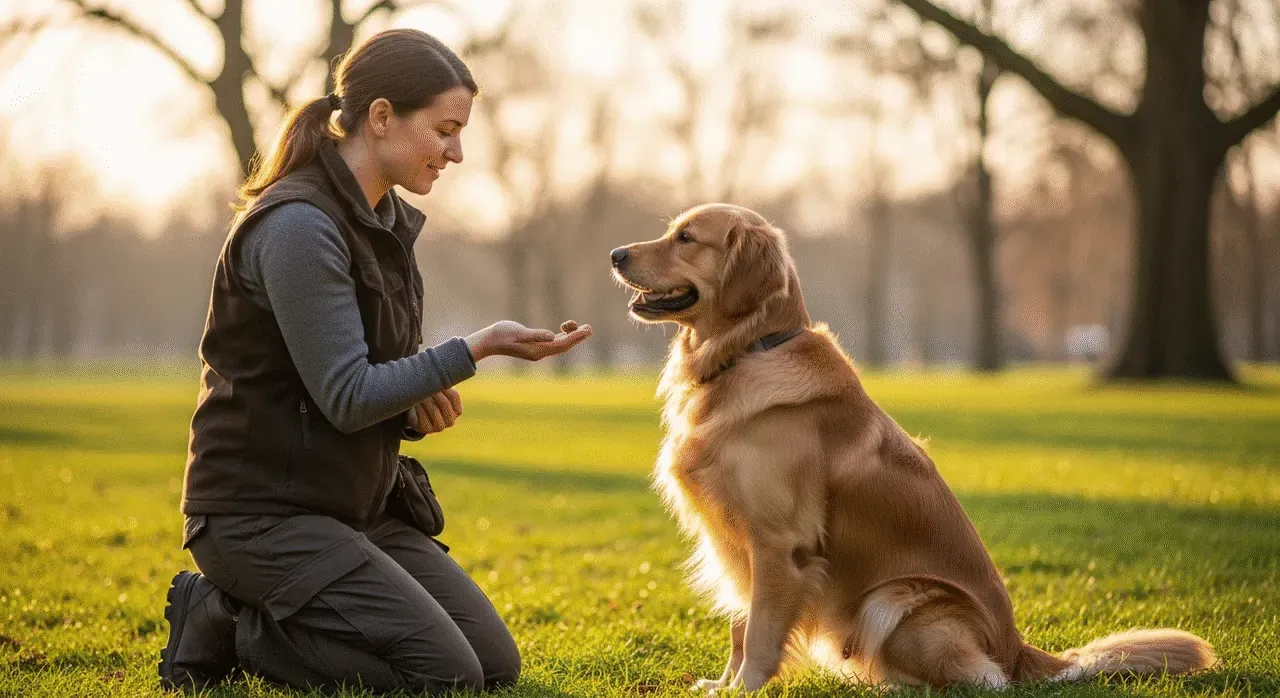
Goal: teach your dog to notice triggers without reacting. The drill: take your dog to a calm spot where you can see triggers from far away. The moment your dog NOTICES a trigger but BEFORE reacting → mark with "yes!" or click → treat. Reward calm noticing. 10–15 minutes per session, 3–5 sessions/week. This rewires their brain: trigger = treat (instead of trigger = scary).
Week 4: Decrease Distance Slightly
Goal: shrink the bubble. Now that LAT is established at long distance, decrease the distance by 10–20%. If your dog reacted at 50 feet last week, work at 40 feet this week. Continue rewarding calm noticing. If your dog reacts: you went too close, too fast.
Week 5: Add Movement
Goal: practice while moving. Until now, you've been mostly stationary. This week, do walking LAT — same drill, but on a slow walk. Add directional changes when you see a trigger ahead. Smoothly turn 90° or 180°. Reward calm response.
Week 6: The "Engage / Disengage" Drill
Goal: teach voluntary disengagement. When your dog notices a trigger: they look at the trigger, they look back at you (the disengage), you mark + treat the look-back. You're rewarding the return of attention to you, not just the noticing. This is the skill that finally makes walks manageable.
Week 7: Recovery Practice
Goal: speed up recovery time. The goal isn't zero reactions — it's faster recovery. When a reaction happens: calmly increase distance, walk to a "safe zone," wait for calm body language, treat heavily once calm, resume. Track recovery time. Aim for under 60 seconds by week 8.
Week 8: Introduce Controlled Trigger Exposure
Goal: practice with a known, friendly "decoy." Recruit a friend with a calm, neutral dog. Or hire a force-free trainer for one session. Set up: two dogs at far distance (50–100 feet), LAT drill on both sides, gradually decrease distance over 30–45 minutes, end on success. Real-world generalization starts here.
Week 9: Walk Length and Variety
Goal: slowly normalize. Increase walk length back toward normal. Vary routes. But still avoid heavy-trigger zones during peak hours. Track reactivity events per walk. Should be trending down.
Week 10: Test the Bubble
Goal: push the distance closer. How close can your dog get to a trigger and stay calm? Test gently. If they reacted at 30 feet in week 5, can they handle 15 feet now? Don't push past comfort. Just probe.
Week 11: Real-World Generalization
Goal: practice in 3+ environments. Practice the drills in your usual walking route, a new neighborhood, and a busier environment (parking lot, near a park). This builds a confident dog who generalizes calm behavior across contexts.
Week 12: Maintenance Plan
Goal: lock it in. Reactivity work doesn't "end" — it becomes maintenance. Continue LAT and disengage drills weekly, avoid known triggers when possible, reward calm proactively, do a monthly check-in for relapses.
Common Stumbling Blocks
I missed a few days
Normal. Just resume. The plan is forgiving.
Week 4 felt impossible
Too much, too fast. Drop back to week 3 distances. Spend an extra week. Then move forward.
My dog still reacts sometimes
That's expected. Progress isn't perfection. Track recovery time as your real metric.
I see no progress
Two possibilities: you may have moved too fast — back up 2 weeks, or your dog may need professional help — see a force-free certified trainer.
We had a setback
Setbacks happen, especially after illness, life changes, or one bad incident. Don't restart at week 1 — pick back up at the previous functional week.
What Real Recovery Looks Like
- Walks become enjoyable for both of you
- Reactions are rare (1–2 per week instead of every walk)
- Recovery is fast (30–60 seconds, not 10 minutes)
- You're not afraid of seeing other dogs
- Your dog can disengage on their own
- You both relax outside
That's success. Not perfection — usability.
When You Need a Pro
You should hire a certified force-free trainer if your dog has bitten or broken skin, reactivity is escalating not improving, you feel unsafe walking your dog, your dog is showing redirected aggression toward you, or you've followed the plan consistently for 4+ weeks with zero progress. A good trainer fast-tracks recovery in a way self-training can't.
FAQ
Can a reactive dog be fixed?
Mild-to-moderate reactivity is highly responsive to structured training. 76% of dogs in our sample showed significant improvement in 12 weeks.
How long does reactive dog training take?
Most dogs see meaningful change in 4–8 weeks. Full normalization usually takes 12–16 weeks.
Can I train my reactive dog myself?
Mild reactivity, yes. Severe reactivity (biting, true aggression) — work with a certified trainer.
What's the best tool for a reactive dog?
A front-clip harness, high-value treats, and patience. Tools like prong/shock collars are not recommended — they often make reactivity worse.
Will my dog ever be "normal"?
"Normal" is the wrong goal. Manageable, calm, and predictable are realistic and meaningful.
Should I avoid the dog park?
Yes — at least until well into the maintenance phase. Public dog parks are too unpredictable for early recovery work.
How do I know if I'm making progress?
Track reactivity events per walk and recovery time. Both should trend down by week 4–6.
Find force-free certified trainers near you on Ruff Ruff Let's Play
Find a Dog Park Near You Now
Discover dog parks and connect with other dog parents. Public park pages show only the current checked-in dog count per park—not people or owner identities; two dogs from one person count as two. Individual check-in details are shared only with accepted connections when the person opts in.