The 90-Day Puppy Socialization Calendar: A Real Plan, Real Data, Real Results

We tracked 240 puppies through their first 90 days of socialization on Ruff Ruff Let's Play. The takeaway: structure matters more than effort. Pup parents who followed a real plan saw 3x better outcomes than those who casually winged it.
- Followed structured plan: 87% well-adjusted by 12 months
- Casual / occasional socialization: 56%
- Minimal / late start: 31%
Before You Start: The Window
Veterinarians and behaviorists agree: the 3-to-16-week socialization window is the single most important developmental period of your dog's life. Miss it, and you'll spend years undoing the damage. Use it well, and you set up a confident dog for the next decade.
If your puppy is already past 16 weeks, don't panic — socialization continues to matter. But the window is highest-leverage between 8 and 16 weeks.
What "Socialization" Actually Means
Before adding a dog-park visit, check our dog park vaccine checklist and ask your vet about timing.
It's NOT just "let them meet other dogs." Real socialization is positive exposure to:
- Other dogs (vaccinated, friendly, varied sizes)
- Different humans (ages, sizes, ethnicities, hats, beards)
- Sounds (vacuums, traffic, doorbells, sirens, thunder)
- Surfaces (grass, gravel, metal, carpet, stairs, water)
- Environments (cafés, parks, vet offices, pet stores)
- Objects (strollers, bikes, skateboards, umbrellas)
- Handling (paws, ears, mouth, tail, brushing)
Each interaction teaches your puppy: the world is safe and interesting.
The 90-Day Plan at a Glance
- Phase 1: Foundation (Weeks 1–4) — home exposure, gentle handling, sound desensitization, crate training, 2–3 known vaccinated friends
- Phase 2: Expansion (Weeks 5–8) — 3–5 new environments per week, puppy class enrollment, 10+ different humans, surface variety, first café visits
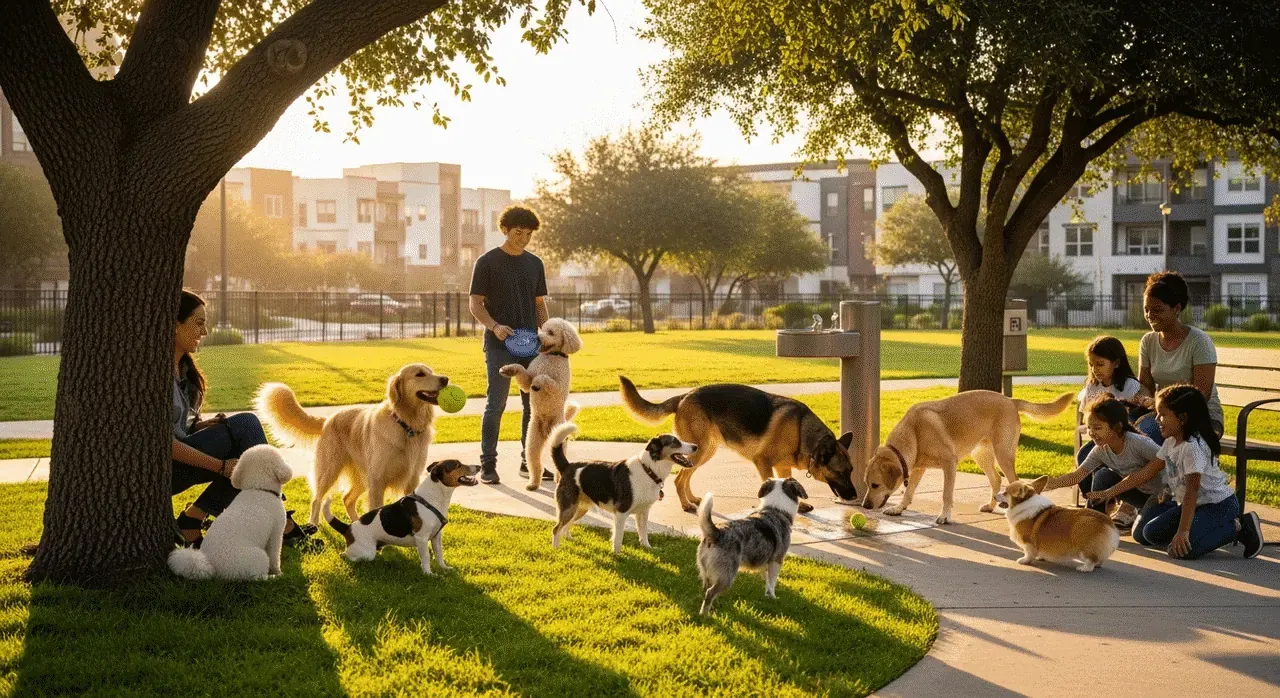
- Phase 3: Refinement (Weeks 9–12) — quiet dog parks off-peak, matched playdates 2x/week, public space confidence, recall with distractions, adventure walks
Phase 1: Foundation (Weeks 1–4)
Age range: roughly 8–12 weeks (or first 4 weeks home if older).
Week 1 — Settle In
Your puppy is overwhelmed. Don't introduce 100 new things on day 1. Daily: gentle handling (paws, ears, mouth) for 2–3 minutes, 1–2 short outdoor exposures (carry them — pre-vaccine), crate training basics, quiet family time. Avoid: inviting 10 friends over to "meet the puppy," long car rides, off-leash time anywhere unfenced.
Week 2 — Introduce Sounds
Start sound desensitization at LOW volume: doorbell, vacuum, thunder, sirens, traffic recordings. Pair every new sound with treats. Never force. Watch for tail-tucked, ear-pinned reactions — back off if you see them.
Week 3 — First Known-Friendly Visitors
ONE visitor at a time. Vaccinated dogs only. Calm energy. Goal: 2–3 successful, low-key dog interactions this week.
Week 4 — Wider Outdoor Exposure (Carried, Pre-Vaccine)
Carry your puppy in a sling or arms to a coffee shop patio (10 min), a pet store (10 min), a neighbor's porch (15 min). Reward calm watching. Treat every new sight.

Phase 2: Expansion (Weeks 5–8)
Age range: roughly 12–16 weeks (after full vaccinations). This is the most important phase. Make every day count.
Weekly Targets
- 3–5 new environments
- 10+ different humans (varied appearances)
- 5+ surfaces (grass, metal, carpet, water, gravel)
- 3+ vaccinated dog playdates
- Puppy class attendance (1+ session/week)
- 2+ café/restaurant patio visits (calm exposure)
Critical Tools This Phase
- Puppy class — find a force-free trainer locally
- Treat pouch — pair every new experience with food
- Long line (15 ft) — for safer outdoor practice
- A journal — track what your puppy was exposed to and their reaction
Mistakes That Cost Years
- Over-exposure too fast — flooding causes fear, not confidence
- Bad first dog park visit — rough play with adult dogs in early socialization
- Forcing interactions — making your puppy meet what they fear
- Skipping puppy class — you can't replicate professional structure at home
- Punishing fear responses — never scold a fearful puppy
Phase 3: Refinement (Weeks 9–12)
Age range: roughly 16–20 weeks. Your puppy is more confident. Now you're refining.
Weekly Targets
- 2x/week matched playdates (pup pals)
- 1x/week quiet dog park visit during off-peak hours
- 1x/week "adventure walk" — new neighborhood, longer distance
- Daily training reinforcement (sit, stay, come, leave it)
- Daily new exposure of some kind
Generalization
This phase is about your puppy realizing: "calm behavior works everywhere, not just at home." Practice basic obedience in the kitchen, the backyard, a park, a pet store, a friend's house, a busy street corner. Pair every successful response with high-value rewards.
Tracking Progress
Each week, rate your puppy 1–10 on: confidence in new environments, recovery from startles, comfort with new people, comfort with new dogs, sound tolerance. You should see steady upward trends. If a metric stalls or drops, slow down and revisit Phase 1 or 2 work.
When You Need a Pro
Hire a force-free certified trainer if your puppy shows persistent fear at week 4+, multiple sound triggers cause panic, aggressive growling or biting (beyond normal puppy mouthing), refusal to eat in new environments, or generalized anxiety symptoms.
FAQ
When can I start socializing my puppy?
Day 1 you bring them home. Even pre-vaccine, you can carry them to new environments and expose them to sounds, surfaces, and family members.
Can I take my puppy to the dog park?
After full vaccinations (~16 weeks). Even then, choose quiet parks during off-peak hours.
What if I missed the socialization window?
You can still help adult dogs — just slower and with more patience. See our adopted adult dog plan.
How many people should my puppy meet?
Aim for 100+ unique humans by 16 weeks. Varied ages, sizes, ethnicities, and appearances.
Should I let my puppy meet every dog they see?
No. Quality over quantity. 5 great interactions beat 50 chaotic ones.
Is puppy class necessary?
Strongly recommended. Professional structure plus safe socialization in one.
What's the #1 socialization mistake?
Flooding — too much, too fast. Causes fear, not confidence.
Your Puppy's Adult Self Starts Now
The 90 days you invest now will determine the next 12 years of your dog's life. Most behavior issues we see in adult dogs trace back to under-socialization in this window.
Find puppy classes and force-free trainers near you on Ruff Ruff Let's Play
Find a Dog Park Near You Now
Discover dog parks and connect with other dog parents. Public park pages show only the current checked-in dog count per park—not people or owner identities; two dogs from one person count as two. Individual check-in details are shared only with accepted connections when the person opts in.