Best Dog Parks for Australian Shepherds: The Exercise and Enrichment Guide

If you have an Australian Shepherd, you already know the deal. You got a dog that was bred to run full tilt across a mountainside herding sheep all day, and you are trying to keep them happy in a house with a backyard. Your Aussie is smarter than half the people you work with, has more energy than a toddler on a sugar rush, and gives you that look — you know the one — that says, "So what are we doing today?" every single morning at 6 AM.
RuffRuff Let's Play helps you discover parks and review listed amenities. Look for agility equipment and open space for running, then connect with dog owners whose high-energy dogs can keep up with your Aussie.
A tired Aussie is a happy Aussie. And the dog park is one of the best tools in your arsenal for getting there. Here is how to make it work.
Why Australian Shepherds need the Dog Park
This is not optional. Australian Shepherds are a herding breed with energy levels that border on absurd. Without adequate exercise and mental stimulation, they become anxious, destructive, and downright miserable. And when an Aussie is miserable, your furniture knows about it.
- Exercise requirements: 1-2 hours of vigorous exercise per day, minimum. Not a casual stroll around the block — real, run-until-they-pant exercise.
- Mental stimulation is just as important. Aussies are one of the smartest breeds on the planet. Physical exercise alone is not enough — they need their brains worked too, or they will find their own entertainment (usually by dismantling something you love).
- Socialization keeps them balanced. Aussies are naturally social and bond deeply with their people and other dogs. Regular park visits maintain those social skills and prevent them from becoming reactive or anxious.
- Without an outlet, they herd everything. Your kids. Your cats. Strangers on the sidewalk. An under-exercised Aussie channels that herding instinct into anything that moves.
What Makes a Dog Park Great for Australian Shepherds
Wide open space
Aussies need room to run. A tiny urban dog park with a patch of dirt is not going to cut it. Look for parks with large, open off-leash areas where your Aussie can stretch out at a full sprint, play extended fetch, and do what herding dogs were built to do — cover ground.
Agility equipment
Jumps, tunnels, weave poles, A-frames — agility equipment is an Aussie's dream. It combines physical exercise with the problem-solving their brains crave. A park with even basic agility obstacles will make your Aussie's tail spin like a helicopter.
RuffRuff Let's Play's Feature Filters let you search for parks with agility equipment. No more guessing or showing up disappointed.
Fetch-friendly zones
If your Aussie loves ball (and let us be honest, what Aussie does not?), you need space for serious fetch sessions. Look for parks with wide, flat areas free of obstacles where you can launch a ball with a Chuck-It and watch your Aussie eat up ground like a furry missile.
Off-leash freedom
Aussies need to run off-leash. On-leash walks are fine for supplemental exercise, but they do not satisfy the deep-in-their-DNA need to sprint, turn, pivot, and explore at their own speed. A well-fenced off-leash park is essential.
Varied terrain
Hills, trails, grass, dirt — varied terrain adds mental stimulation to physical exercise. An Aussie navigating different surfaces and elevations works harder and stays more engaged than one running on flat, featureless ground.
The Australian Shepherd Park Personality
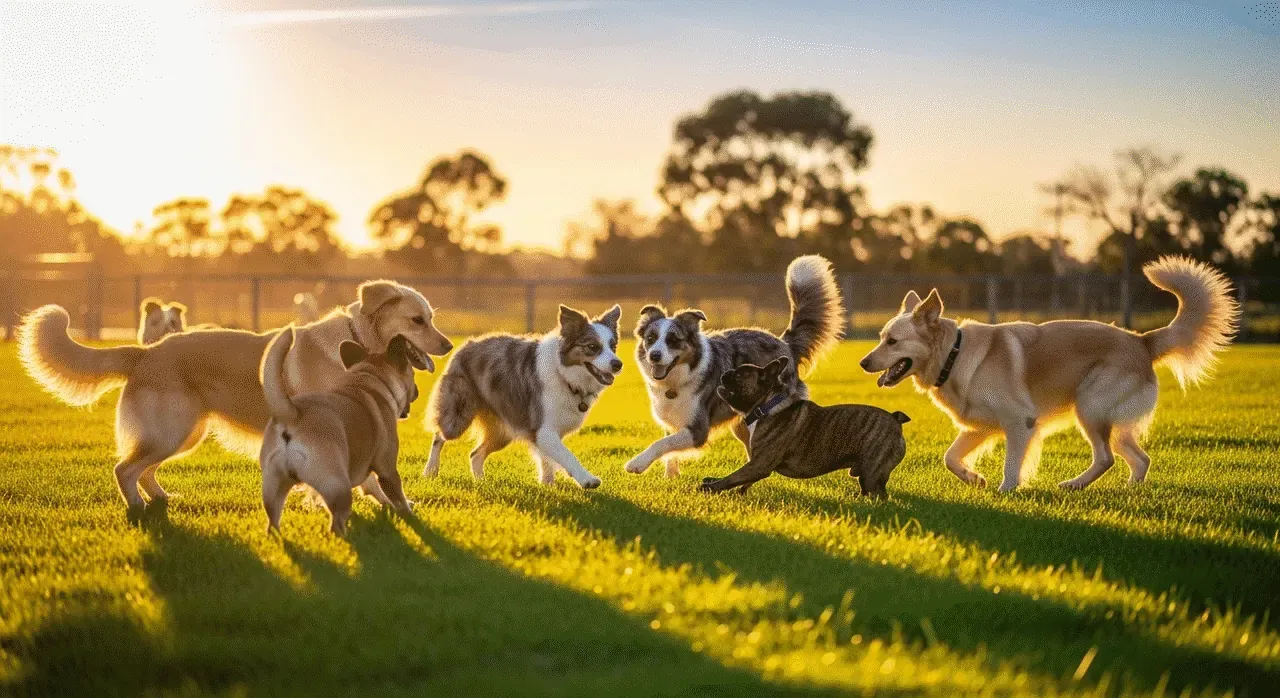
Every breed has a park personality, and the Aussie's is unmistakable. Your Australian Shepherd is the one organizing everyone else at the park. They are the social director, the activities coordinator, and the self-appointed herding supervisor — all rolled into one gorgeous, merle-coated package.
- They will try to herd other dogs into a group. It is instinct, not aggression.
- They are the first to initiate play and the last to want to leave.
- They make friends with every dog and every human at the park.
- They somehow always know where every single dog in the park is at all times.
- They will bring you the ball seventeen times in a row and never, ever get tired of it.
Mental Stimulation at the Park
Physical exercise is only half the equation for an Aussie. Here is how to work their brain at the park:
Training sessions between play
Use park time as a training opportunity. Practice recall, heel, stay, and trick work between fetch sessions. The park provides high-distraction proofing that strengthens obedience in real-world settings.
New routes and exploration
If the park has trails, take a different one each visit. New smells, new sights, and new terrain keep your Aussie's brain engaged. A familiar loop gets boring fast for a dog this smart.
Herding-style games
Bring a herding ball (a large, heavy ball your dog pushes with their nose and body). This channels their herding instinct into a productive activity and provides serious mental engagement.
Obstacle courses
If the park has agility equipment, create mini courses. Tunnel, jump, weave, A-frame — chain sequences together and increase difficulty over time. Aussies live for this.
Managing Herding Behavior at the Park
Here is the thing: not every dog at the park appreciates being herded. Your Aussie thinks they are organizing a productive team activity. The border collie mix might agree. The nervous rescue poodle absolutely does not.
- Learn to recognize herding behavior: circling other dogs, nipping at heels, body blocking, staring intensely.
- Redirect herding to appropriate outlets — a ball, a herding ball, or a game of fetch — when you see it start.
- Practice a strong recall command so you can break your Aussie out of herding mode.
- Introduce your Aussie to calm, confident dogs who will not be flustered by herding attempts.
- If herding escalates to nipping or chasing dogs who are clearly stressed, intervene immediately and take a break.
The goal is not to eliminate the herding instinct — that is hardwired. The goal is to manage it so everyone at the park has a good time.
Socialization Tips for Australian Shepherds
Aussies are smart and social, but they can also be intense. Proper socialization makes the difference between an Aussie who is the park's beloved social butterfly and one who overwhelms every dog they meet.
- Start young. Early socialization (8-16 weeks) sets the foundation. Expose your Aussie puppy to different dogs, people, environments, and stimuli in positive, controlled ways.
- Match energy levels. Aussies play hard. Pair them with dogs who can match their intensity. RuffRuff Let's Play's Paw-fect Matches feature finds high-energy playmates who can actually keep up with your Aussie.
- Teach an off switch. Aussies can struggle to self-regulate during play. Practice settle commands and enforce calm breaks mid-play so your Aussie learns to downshift.
- Diverse experiences. Take your Aussie to different parks, at different times, with different dogs. Variety builds adaptability and confidence.
How RuffRuff Let's Play Makes Parks Work for Aussies
RuffRuff Let's Play (ruffruffletsplay.com) gives Australian Shepherd parents the tools to find the right park every time:
- Feature Filters for agility and open space. Search for parks with agility equipment, large off-leash areas, and the features that matter for high-energy herding breeds.
- Paw-fect Matches. Find dogs matched by energy level and play style. Your Aussie gets paired with playmates who actually want to run, wrestle, and play at Aussie intensity.
- Park discovery. Review listed details and contact the park for current conditions. Consider what crowd level suits your Aussie before you visit.
- Groups. Connect with other Aussie owners and herding breed parents. Share tips on the best parks, the best times, and the best playmate matches.
- Book a Playdate. Set up focused play sessions with compatible high-energy dogs instead of hoping for a good random mix at the park.
Frequently Asked Questions About Australian Shepherds and Dog Parks
How much exercise do Australian Shepherds need?
Australian Shepherds need 1-2 hours of vigorous exercise per day, combined with mental stimulation. A midday dog park visit with fetch, running, and agility is one of the best ways to meet these needs. Without sufficient exercise, Aussies become anxious, destructive, and difficult to manage.
Do Australian Shepherds do well at dog parks?
Yes, Australian Shepherds generally do very well at dog parks. They are social, athletic, and thrive in off-leash environments with room to run. The main thing to manage is their herding instinct, which can annoy other dogs if left unchecked. Parks with agility equipment and open space are ideal.
What are the best activities for Australian Shepherds at parks?
Fetch with a ball launcher is the classic Aussie park activity. Agility equipment, herding ball games, trail running, frisbee, and training sessions between play are all excellent. Aussies also benefit from varied terrain and new routes that provide mental stimulation alongside physical exercise.
Your Aussie Was Built for the Park — Find the Right One
Australian Shepherds were bred to work all day across open terrain. The dog park is the modern version of that — the place where they can run, think, play, and be the incredible athletic dogs they were born to be. Give your Aussie a park with room to run, equipment to climb, and friends who can keep up, and you will see the happiest dog alive.
Find parks with agility equipment and open space on RuffRuff Let's Play.
Explore off-leash dog parks near you on RuffRuff Let's Play.
Find a Dog Park Near You Now
Discover dog parks and connect with other dog parents. Public park pages show only the current checked-in dog count per park—not people or owner identities; two dogs from one person count as two. Individual check-in details are shared only with accepted connections when the person opts in.